
How to Build an Annual Employee Wellness Program
Turn one step challenge into a year-round employee wellness program: mix modes, go beyond steps, share the admin work, and build on what worked.
Your step challenge was a hit. The leaderboard stayed busy all month, a few team names were questionable in the best possible way, and by the final week someone asked the question every program owner loves to hear: what's next?
That question is where an annual employee wellness program starts. An annual program is a planned year of challenges that builds on itself, with each one bringing people back and setting the goal for the next. With Stridekick, that can look like a few big company-wide moments, shorter seasonal challenges, and smaller challenges run by teams and employees in between. Here's how to build one, from your first anchor challenge to the moment employees start running their own.
What's the difference between a step challenge and an annual employee wellness program?
A step challenge is one event with a start date and a finish line. An annual employee wellness program is the structure around many of them: different ways to play, different healthy habits, different people running things, and every challenge informing the next.
You can hear the difference in how people talk about it. Before the first challenge, the question is "What's Stridekick?" By the fourth, it's "What's our next challenge?" That shift is the goal. Here's more on why a lineup of challenges builds stronger habits.
What does a year-round employee wellness calendar look like?
A simple place to start is three or four anchor challenges across the year. Then layer in shorter seasonal or team-led challenges where they make sense.
The three layers of an annual wellness program
- Anchor challenges: your big company-wide moments, like a New Year kickoff, a summer team competition, STEPtember, and a year-end wrap. These get the full launch and leadership joining in. Pick their prizes from these prize ideas straight from the Stridekick Shop.
- Seasonal challenges: shorter challenges, often 7 to 14 days, tied to awareness months or the time of year.
- Community challenges: smaller challenges run by other admins or by employees themselves.
A sample employee wellness calendar by quarter
Here's one way a year could come together:
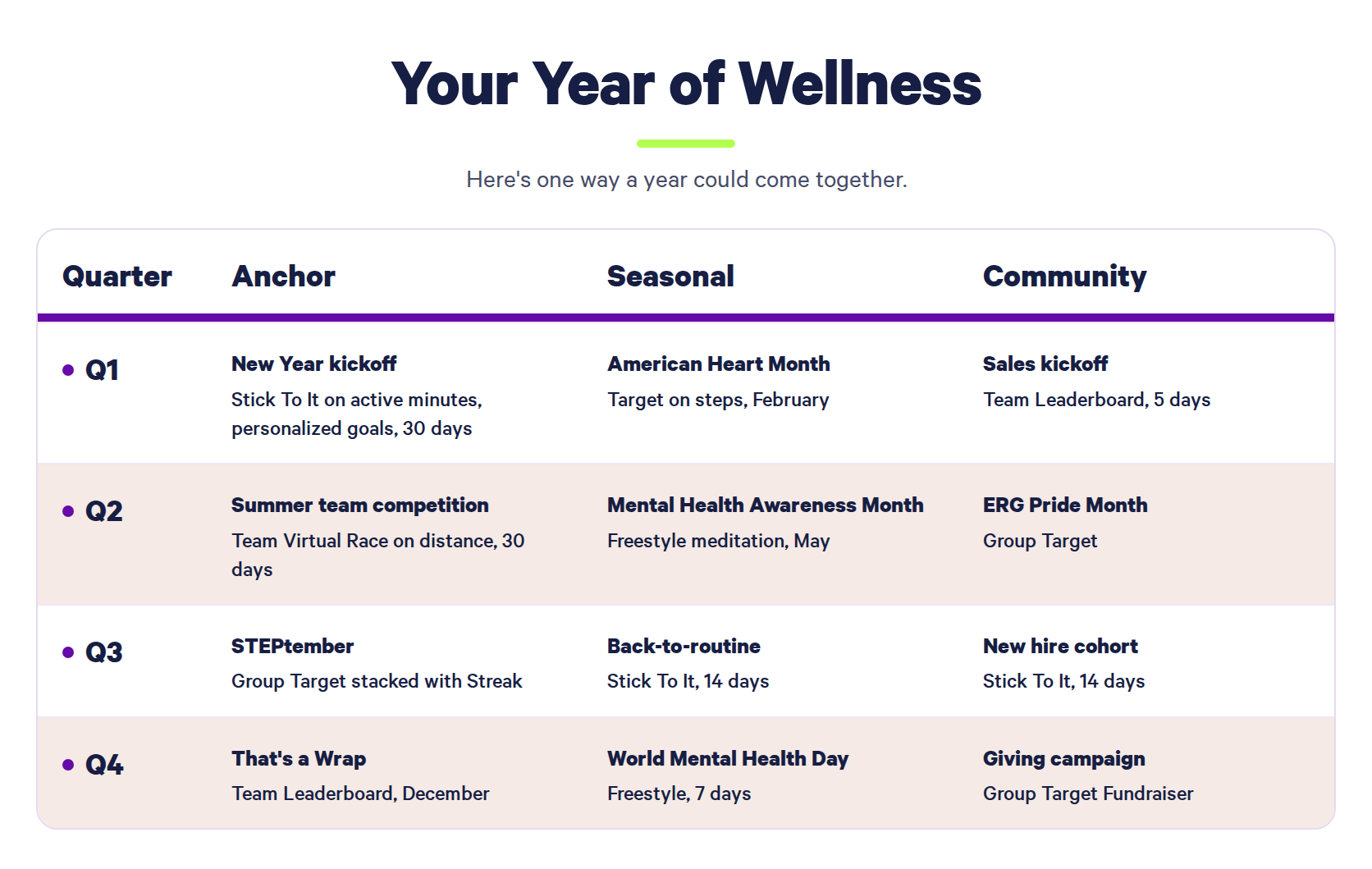
Plan the anchors first, since they carry your biggest launches, then let the other layers fill in around them. For specific ideas in every month, pull from the Annual Fitness Challenge Calendar.
How do you keep workplace wellness challenges fresh all year?
Change the experience as the year goes on. Kick off January with personal consistency. Bring teams together in summer. Give everyone a shared goal in the fall. Finish the year with something short and fun. Three levers make that easy, and you can mix and match all of them.
Switch the challenge mode
Stridekick Unlimited includes all 11 challenge modes. A Stick To It celebrates consistency, a Team Leaderboard sparks friendly rivalry, and a Group Target gets everyone chasing one shared number. The Ultimate Guide to Stridekick Challenge Modes covers all 11.
Switch the activity metric
Activity modes score steps, distance, or active minutes. Active minutes lets a yoga flow or a swim count as much as a long walk, and distance gives a Virtual Race a real finish line. Running the same mode on a new metric makes it feel like a brand-new challenge.
Stack up to three challenge modes
A Leaderboard plus a Streak gives competitors a ranking and everyone else a daily goal to protect. Here's how stacking challenge modes boosts engagement.
Length is one more easy switch. A 7-day Streak and a 30-day Virtual Race feel like completely different events, and we recommend keeping most challenges to 30 days or less.
How do you run wellness challenges beyond steps, like sleep, hydration, and meditation?
Use Freestyle mode. Freestyle turns almost any healthy habit into a challenge. Participants mark the habit complete in the Stridekick app each time they do it, so it works for things no tracker can measure.
Freestyle wellness challenge ideas for non-step habits
- Hitting a daily water goal
- A 5-minute meditation
- Screens off by 9 p.m.
- A stretch break between meetings
- Twenty minutes outside
- A daily gratitude note
For a sleep theme, try a Freestyle habit like "lights out by 10:30." Sleep data already shows up in each person's own Stridekick stats, and the Freestyle habit turns better sleep into something the whole group works on together.
Every Freestyle theme has a home in the Stridekick Shop too. Sleep essentials, hydration picks, and the Stridekick Shop mindfulness collection give participants gear that helps the new habit stick.
Pair Freestyle with an activity mode when you want both. A Mental Health Awareness Month challenge could stack Stick To It (30 active minutes, 10 times) with a Freestyle meditation habit, giving movers and mindfulness fans the same finish line. Browse more creative Freestyle challenge ideas.
Over a year, Freestyle is how Stridekick grows from your step challenge app into the home for every wellness challenge you run.
How do you make a wellness challenge inclusive for every fitness level?
Turn on personalized goals. On Streak, Stick To It, and Target challenges, admins can set a goal range in SuperDash and let each participant pick their own target within it.
Picture a 30-day Streak with a range of 4,000 to 10,000 steps a day. Someone building a new walking habit picks 4,000 and protects that streak all month. A marathon trainer picks 10,000. Same challenge, same chat, two goals that fit two real lives.
Personalized goals shine in anchor challenges, where you want the widest possible audience to join and stay in. Here's how to set up personalized challenge goals.
Which awareness months should anchor your employee wellness calendar?
Awareness months give every challenge a built-in reason to launch. A few that fit naturally:
- January, New Year: Stick To It with personalized goals, so resolutions start at the right size.
- February, American Heart Month: Target, with a cumulative monthly steps goal.
- April, National Walking Day and Earth Day: a 14-day Group Target leading up to April 22.
- May, Mental Health Awareness Month: Freestyle meditation stacked with Stick To It.
- September, STEPtember: Group Target, with a Streak stacked on for a daily goal.
- October 10, World Mental Health Day: a 7-day Freestyle mindfulness challenge.
- November, Giving Tuesday: a Group Target Fundraiser.
- Open enrollment and year-end: pair a December That's a Wrap challenge with a nudge to browse HSA/FSA picks in the Stridekick Shop, especially for employees whose plans have a year-end deadline. Here's what to buy first with your HSA/FSA.
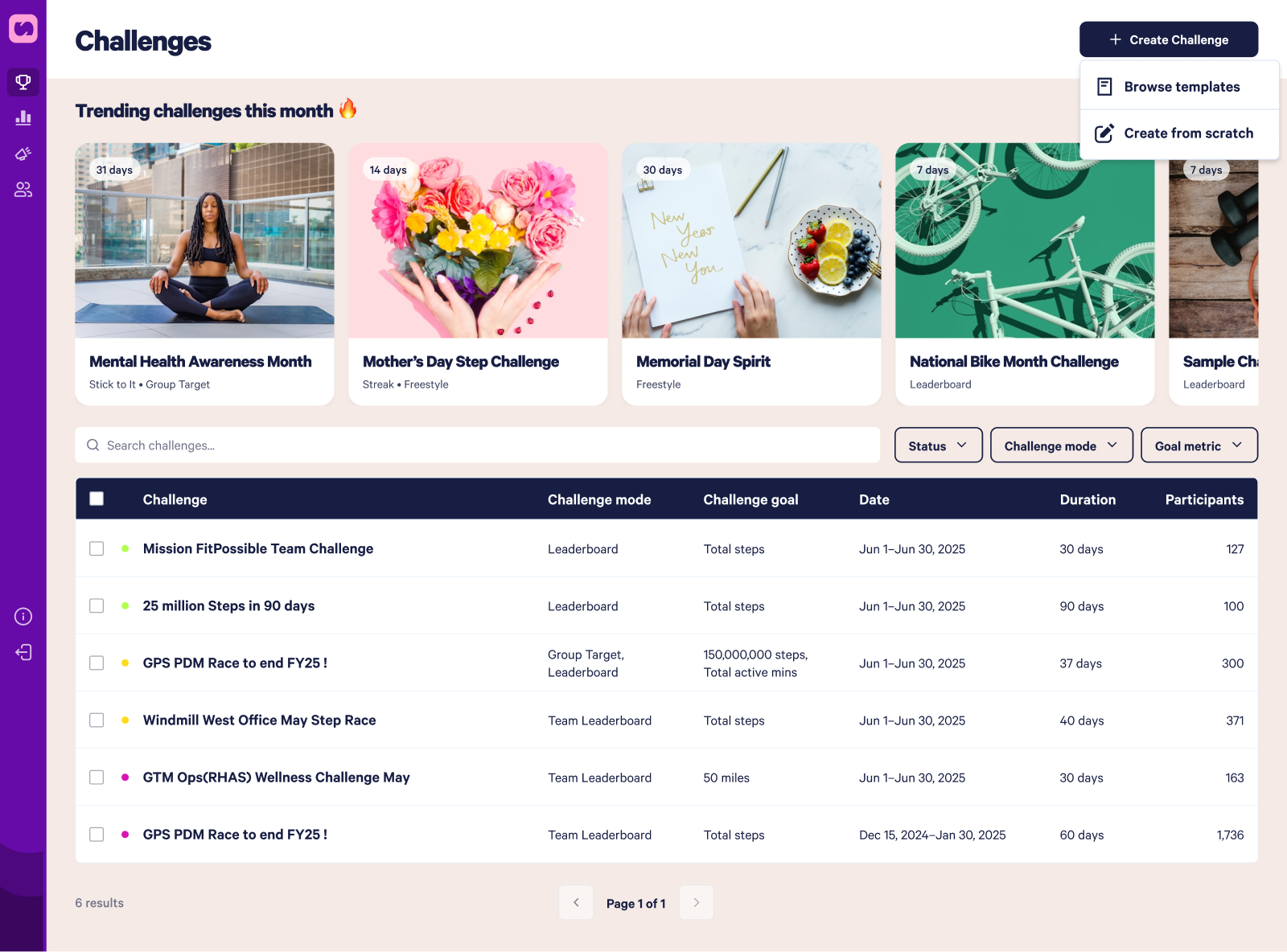
Seasons work just as well: spring for getting outside, summer for team competitions, fall for back-to-routine consistency, and the holidays for short streaks that fit busy calendars. In SuperDash, the Trending this month row surfaces templates for upcoming moments.
How do you plan a year of wellness challenges with less setup?
Two SuperDash features do most of the work: Challenge templates and Duplicate.
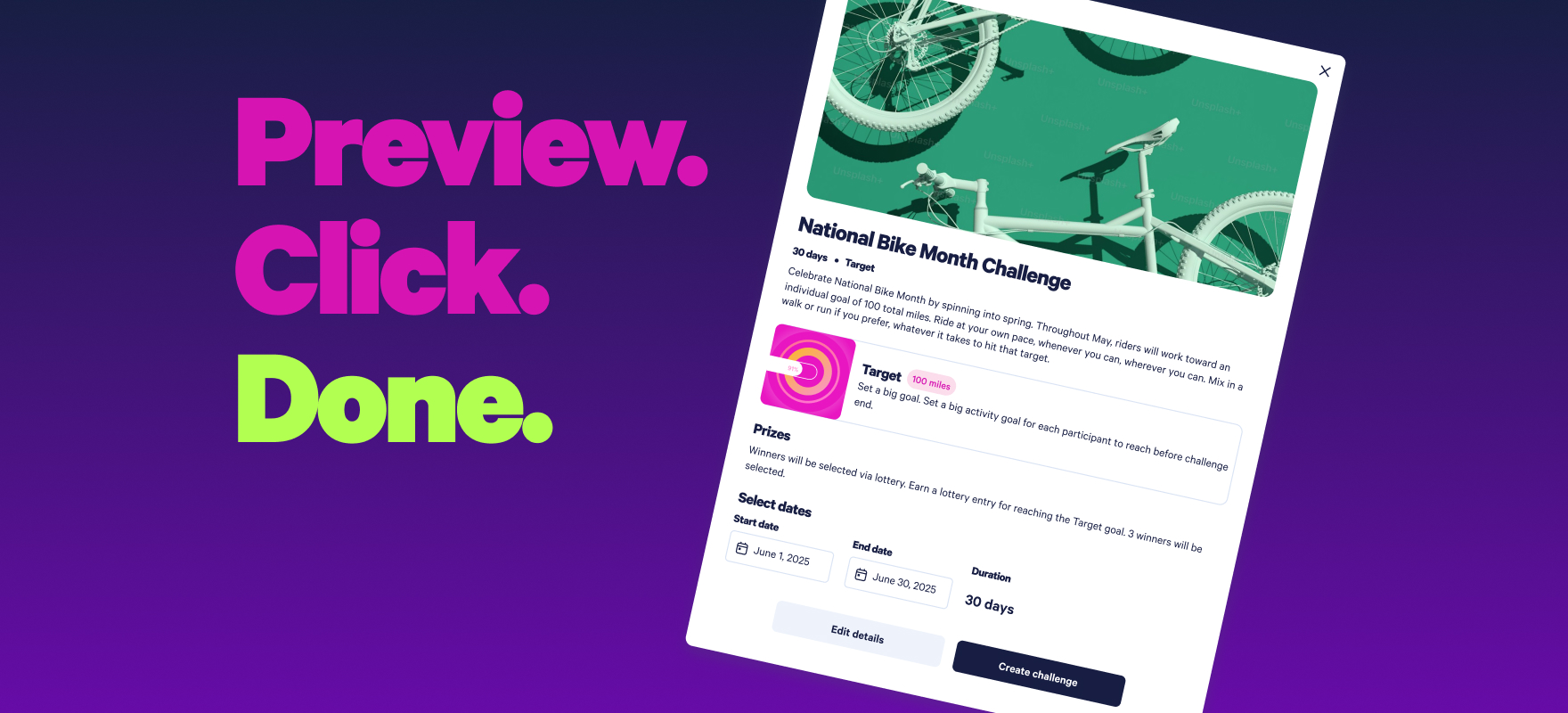
Launch from 100 ready-made challenge templates
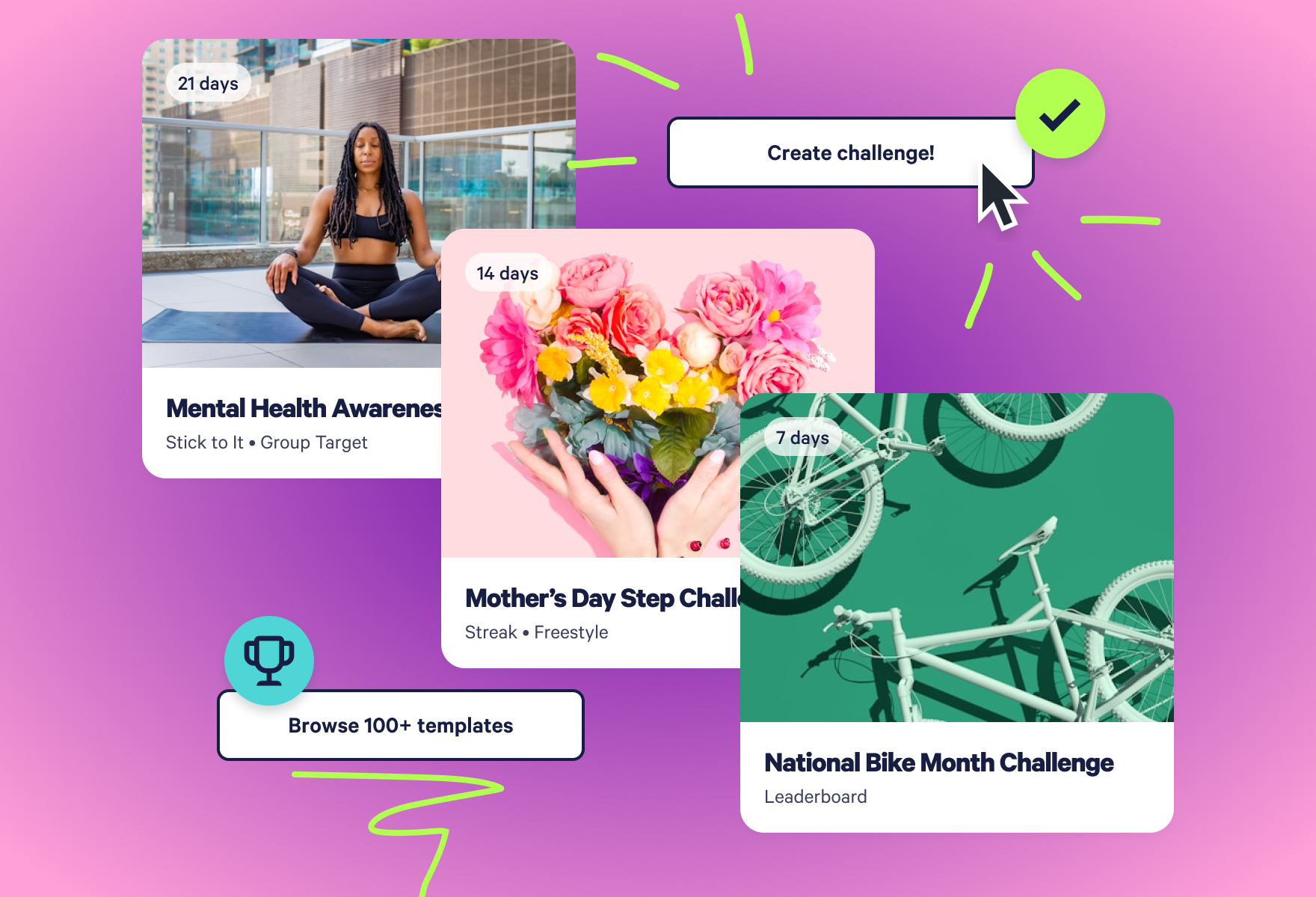
Stridekick has 100 ready-made templates for seasons, holidays, awareness months, and popular wellness goals. Each comes with a name, description, cover image, mode, goal, metric, prize strategy, and suggested duration. Pick one, set a start date, and launch in one click, or edit the details first. Browse 100+ employee wellness challenges ready to launch.
Duplicate the challenges that worked
When a challenge works, duplicate it in SuperDash. Stridekick copies the modes, teams, goals, and structure. Update the dates, tweak anything you like, and launch.
How do you use last year's wellness challenge results to set new goals?
Treat every challenge as a starting line for the next. When a challenge ends, pull the Challenge Mode Report in SuperDash. It includes scores, totals, and daily activity for each mode.
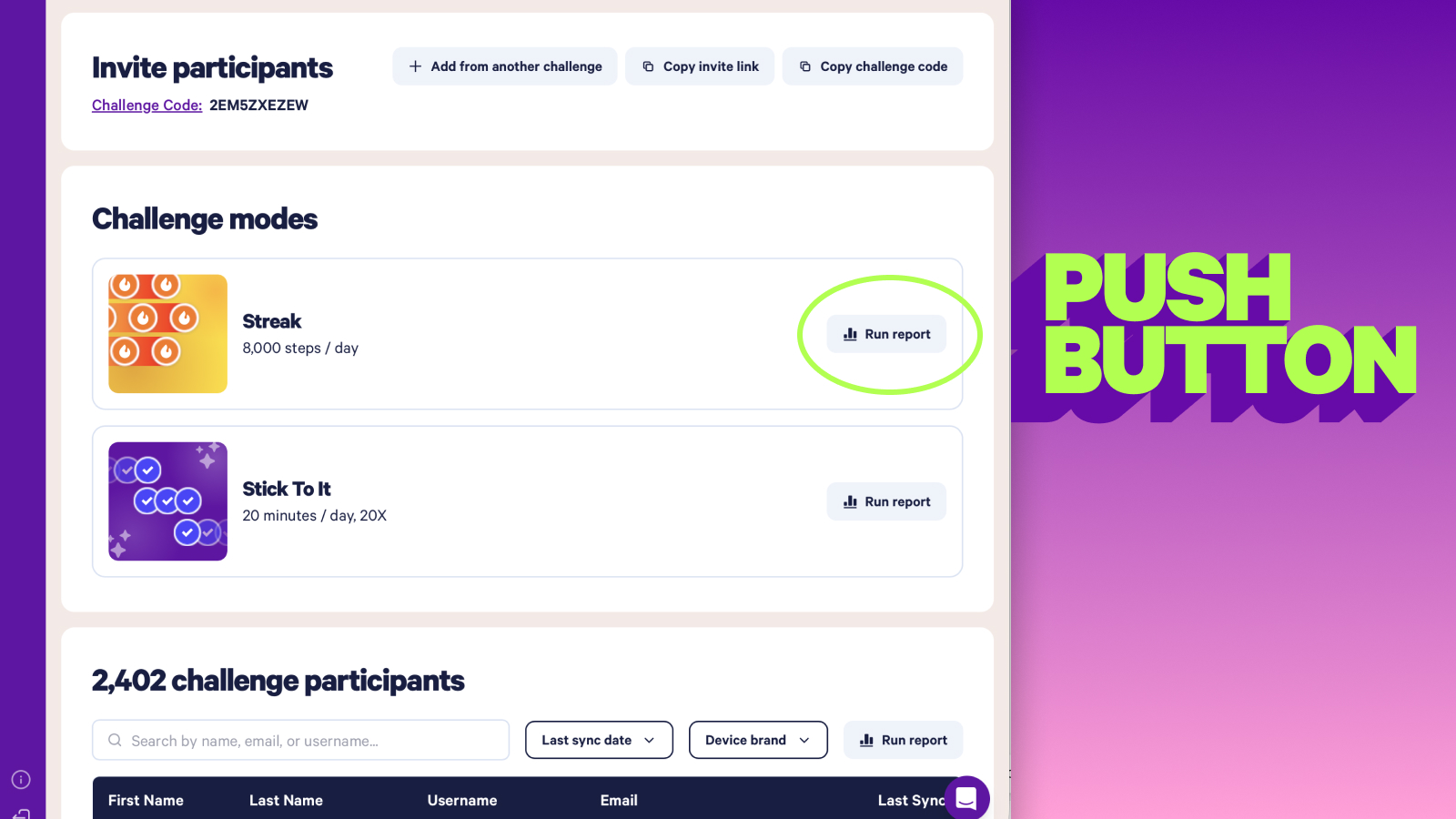
How to calculate your next challenge goal
Say your spring Group Target had 150 participants walk 18,000,000 steps over 30 days. That averages 4,000 steps per person per day (18,000,000 ÷ 150 ÷ 30).
This year, aim a little higher: 20,000,000 steps. With the same 150 people over 30 days, that's about 4,444 steps per person per day. If enrollment grows to 170, the same goal drops to about 3,922 per person per day, so recalculate once final enrollment is in.
Turn the new goal into a story
Now the challenge has a headline: "Last spring we walked 18 million steps. Let's hit 20." Put a prize on the record-breaking moment. Once the group passes the old total, raffle three recovery picks from the Stridekick Shop among everyone who logged activity during the challenge.
A quick debrief sharpens the next one. Ask what got people to join, which mode kept them engaged, and whether the goal had room to stretch.
How do you grow employee participation with every challenge?
Your first challenge might bring in 50 people. When you duplicate it, Stridekick automatically enrolls those same participants, so challenge two starts with your community already in it. That frees up your promotion for the people who haven't joined yet.
Your most engaged participants are your best recruiters. Ask a few of them to be champions and share the challenge link with their teammates. Invite new hires into the next one. Post an announcement celebrating the last total and inviting everyone to help beat it.
Thank your champions with a Stridekick Shop pick of their choice. And remind newcomers that a smartphone is all they need to join, with wearables in the Shop for anyone ready to upgrade.
Over time, each challenge grows the community around it.
Who else can run fitness challenges?
The goal is to give more people across your company the tools to create wellness moments of their own. Stridekick Unlimited supports up to 10 admins in SuperDash, including the Owner. The Owner adds and removes admins, and each admin can create and manage challenges, post announcements, and pull reports.
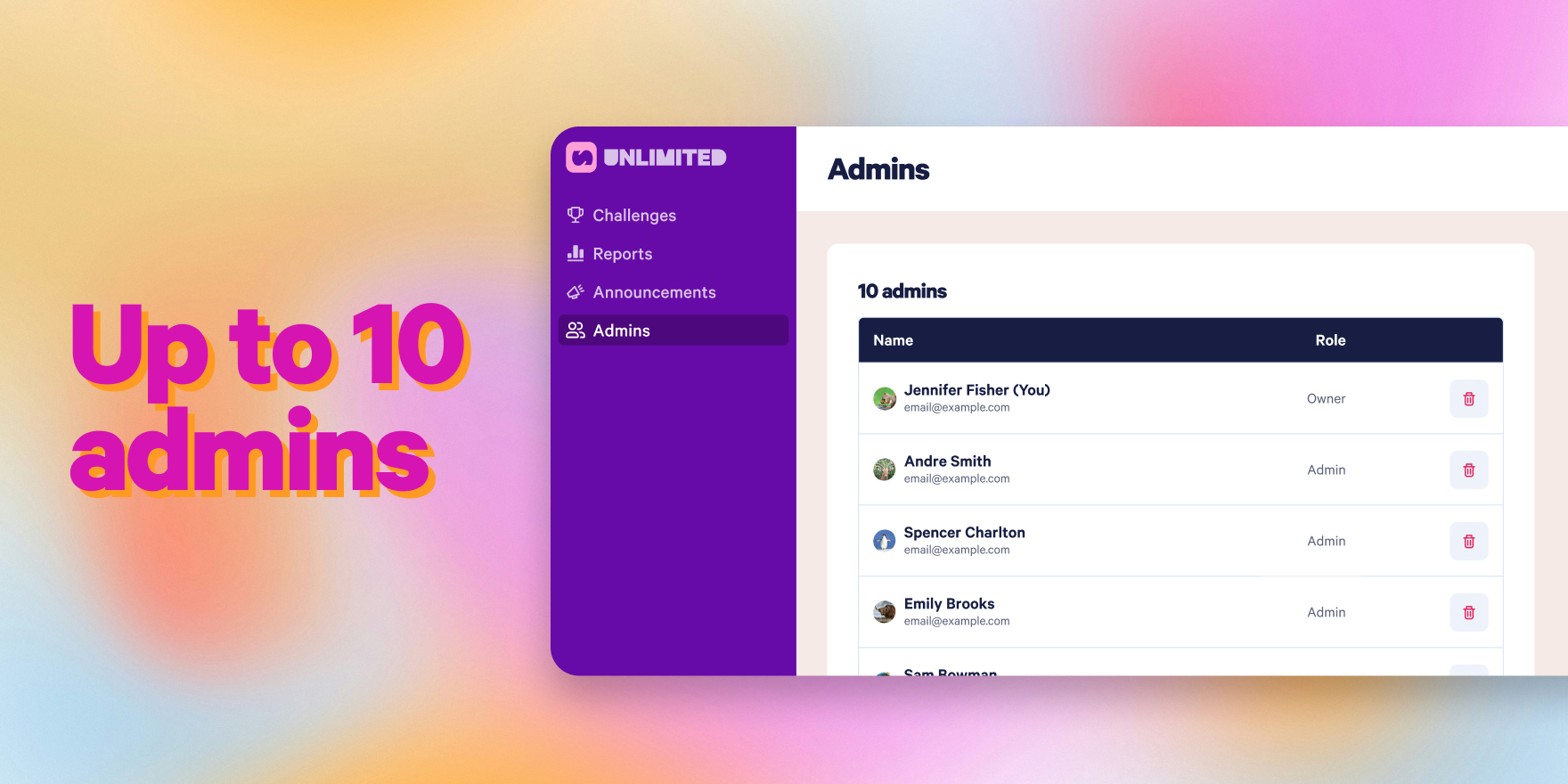
That opens up a natural spread of ownership:
- HR or People runs the anchor challenges.
- A culture committee takes the summer competition.
- An office lead runs a regional rivalry.
- An ERG lead runs a heritage-month Group Target.
- A wellness champion owns Mental Health Awareness Month.
For more ideas by department, see 10 ways teams across your company can use Stridekick. Here's more on making anyone at your company a challenge admin.
Employees can start their own challenges too. Anyone with a free Stridekick account can create a Free challenge: public, up to 10 participants, up to 7 days, using core modes like Leaderboard, Streak, and Target. It's a great fit for fun weekly mini-challenges, like a step-off with the people you sit next to. When an employee's idea is ready for the whole company, the Owner can make them an admin.
Company-led, then team-led, then employee-led. That's how one wellness event becomes an organization where different people create moments all year.
How does the Stridekick Shop keep your wellness program going between challenges?
With annual access, Stridekick stays the place employees already know to go, and the Stridekick Shop is a big reason why. It lives right inside the Stridekick app, so every participant can browse, save, and shop wellness picks on their own schedule. Brands work directly with Stridekick on special pricing and limited-time offers.
.jpg)
That makes the Shop your easiest between-challenge touchpoint:
- Feature a pick in your announcements. After a big Virtual Race, point people to recovery gear. Before a mindfulness month, share a few calming favorites.
- Make benefits season personal. Nearly half of Shop products are HSA/FSA eligible, so employees can put pre-tax dollars toward gear that supports their goals.
- Let everyone build their own health stack. The Shop surfaces personalized picks and saved lists, so there's always something new waiting.
Admins can also post announcements anytime to share results or tease what's next, and monthly community challenges stay open for anyone to join. When a moment pops up, from a product launch to the first sunny week of spring, an admin can launch a challenge from a template the same day.
Your annual employee wellness program checklist
- Pick 3 to 4 anchor challenges and put them on the calendar.
- Add seasonal challenges around the awareness months your people care about.
- Give each anchor a different mode or metric, or stack up to three modes.
- Add at least one Freestyle challenge for a non-step habit.
- Invite a few more admins and give each one a moment to own.
- Ask your most engaged participants to bring teammates into the next challenge.
- Feature a Stridekick Shop pick in your announcements between challenges.
- After every challenge, pull the report, set the next goal, and duplicate what worked.
Build your year-round wellness program with Stridekick
One challenge can get people moving. An annual program gives them a reason to keep coming back.
Start with a few big moments. Change the way people participate. Bring in new admins. Learn from what worked. Let employees create challenges of their own. Every launch builds on a community that's already there.

Stridekick Unlimited gives you unlimited challenges, 100 templates, up to 10 admins, and the Stridekick Shop right inside the app for every participant. Explore Stridekick Unlimited and start planning your year.
Quick answers about annual employee wellness programs
How many challenges should an annual employee wellness program include?
A simple place to start is 3 to 4 company-wide anchor challenges across the year. From there, layer in shorter seasonal or team-led challenges where they make sense.
Can employees outside HR run wellness challenges?
Yes. On Stridekick Unlimited, the Owner can add up to 10 admins total, and each admin can create and manage challenges in SuperDash. Employees without admin access can create Free challenges for up to 10 people and up to 7 days.
Can a workplace wellness challenge track habits besides steps?
Yes. Stridekick's Freestyle mode lets participants log custom habits like hydration, meditation, stretching, or a consistent bedtime. Activity modes score steps, distance, or active minutes.
How do you keep employees engaged between wellness challenges?
Post announcements to share results and tease the next challenge, keep monthly community challenges open, and point people to the Stridekick Shop. The Shop lives inside the Stridekick app, so employees can browse wellness picks, save favorites, and use HSA/FSA dollars on eligible items anytime.