
Plunge Pod vs. Plunge All-In vs. Echelon Smart Cold Plunge: Finding the Best Home Cold Plunge
Thinking about investing in a home cold plunge? We compare three popular options, from cooling power and filtration to comfort and cost, with expert tips to help you choose.
Plunging into icy waters might not be the typical idea of a good morning. But it’s a strangely addictive, invigorating ritual, with benefits ranging from mental clarity to reduced inflammation and metabolism support. As is often the case, consistency is key to ongoing results, which is why the home cold plunge is steadily gaining popularity.
If you’re in the market for your very own cold plunge, you have many an option to choose from. To narrow your search, with the help of personal trainer and avid cold-plunger Peter Feysa, we’re taking a cold, hard look at three leading options: Plunge Pod, Plunge All-In, and Echelon Smart Cold Plunge.
The Expert
- Peter Feysa, CPT, founder of STATE360 Fitness & Performance
What to Look For in a Home Cold Plunge
Before getting into product specifics, let’s sketch out the features to look for in an at-home cold plunge. According to Feysa, there are a few key elements you shouldn’t skim over.
The Chiller
The steep price of a cold plunge chiller might tempt you to rely on the humble ice cube. But that’s not realistic for most of us, and it could hold you back from actually using your tub.
“The chiller is by far the most important feature of the cold plunge tub, and of course, the most expensive. You’re looking for speed of chilling, and reliability. This little unit will be running in all seasons and temperatures if outside,” says Feysa.
“If you’re planning on just using ice for your tub to save money, think again. Understand that you’ll be spending up to $15 per session for the ice alone if you’re purchasing from the store, and the wait time alone to get the water cold enough will be more than enough hassle to stop you from using it regularly. I did this in the beginning and it motivated me to invest in the more expensive model within 5 sessions,” he adds.
“The great thing about all of the chillers here (Plunge Pod, Plunge All-In, and Echelon Smart Cold Plunge) is that they all have chillers that go as low as 39 degrees,” says Feysa. That’s great news, and we’ll dig a little deeper into those details later.
The Filter
Feysa experienced firsthand how a flimsy filter can deteriorate your cold plunge experience: “People underrate this until it’s too late, like me when I first started. Dirty water and an unclean filter can ruin a chiller if left unchecked,” he warns.
“When I set up my first cold plunge, I used the older model’s plastic filter. After 5 months, it broke. But since I didn’t know I had to check it daily, I clogged up my chiller’s pipes and almost wrecked the entire unit, throwing nearly $4,000 out the window. FYI, if you don’t have a metal mesh filter, it will most likely crack and break within the first 5 months. Make sure you get a metal mesh filter from the start.”
“You want to buy a chiller that allows you to take a quick peek at the filter through a plastic or glass case without having to unscrew or open the chiller itself, which can be a pain if you check daily (which is the goal).”
And factor a quick clean into your cold plunge routine: “Most units come with a little net to clear away any leaves or debris you track into the tub on a regular basis to avoid a hefty clogged-up filter. Using that little net will be a lifesaver for your chiller if you use it often,” says Feysa.
The Seal
While it’s not the snazziest of features, the seal on your cold plunge will make a big difference in how much it costs over time. And, equally as importantly, it helps keep your plunge bug-free.
“You want to make sure that you’re insulating as much of the cold water as possible to keep your electric bill down, and the bugs out. When I first started plunging, I couldn’t figure out how all the bugs were getting inside. The tighter the seal, the more you can avoid the high bill and keep the bugs out.”
The Orientation
This next feature does depend somewhat on preference. But if you’re not yet sure what you’d prefer, you can consider Feysa’s recommendation of a vertical tub.
“I would strongly recommend the vertical tub vs. the horizontal bath version for the ease of getting in and out. It’s way easier to get the water above your shoulders when you can hop right in with the vertical tub, than if you have to take the extra few seconds to lie down in nearly freezing water in the horizontal tub version.”
Not Worth the Squeeze: Fancy App Features
As for features that typically aren’t worth the extra cash, Feysa highlights flashy app setups.
“You don’t need all the advanced app features that cost extra. You’ll mostly likely be setting the temperature once, and adjusting every week or so. Spend the extra money and resources on the chiller itself, which again is by far the most important.”
Bonus Tip: Consider Drainage
While this doesn’t concern your choice of tub, it’s wise to consider before purchasing:
“Pick a spot that will allow you to drain it with ease. The tub will be holding 100 gallons or more of water, and you don’t want to be in an area that has water sensitivities, can cause electrical damage, etc.,” says Feysa.
“The coolers do emit a bit of a humming sound, so make sure you’re aware of that if you’re placing it near your bedroom,” he adds.
Now onto the review!
Plunge Pod vs. Plunge All-In vs. Echelon Smart Cold Plunge: What’s the Best Home Cold Plunge?
Plunge Pod, Plunge All-In, and Echelon Smart Cold Plunge are 3 solid at-home cold plunge options offering different specs, special features, and setups. They all have their strengths, but they might not all be a match for your routine. Below, we break down the most notable differences, with expert insights to help inform your purchase.
Worth noting: All of these tubs are HSA/FSA eligible in the Stridekick Shop, so you may be able to use your pre-tax funds to make them more affordable.
Plunge Pod: Best for Vertical Plungers
Pros:
- Vertical orientation
- Space-efficient
- Indoor/outdoor design
Cons:
- Chiller is an add-on purchase
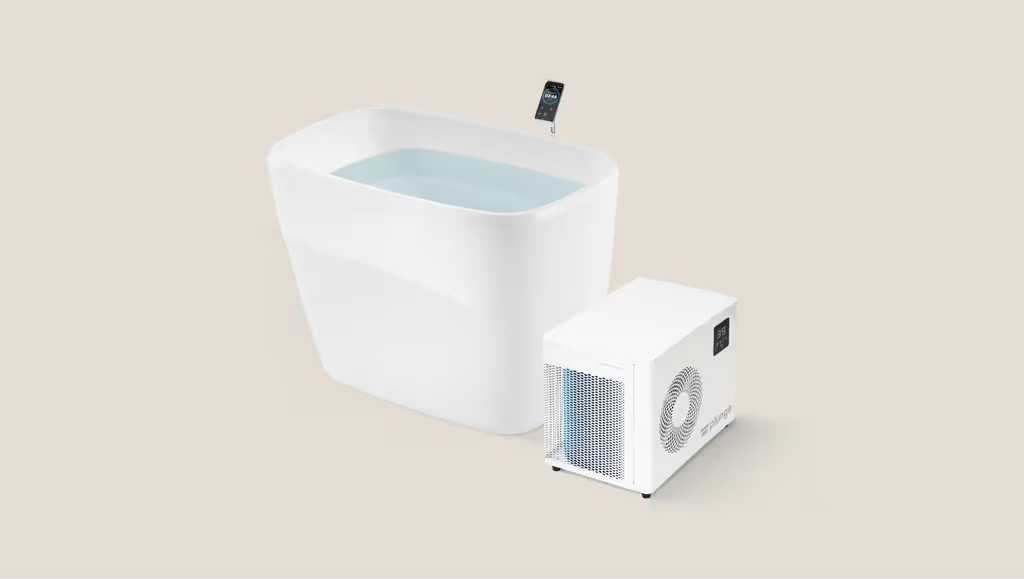
Expert opinion: “The only vertical tub of the three, which is the one I would pick (by far) for getting in and out easily. Just know the base price is tub-only with no chiller or filtration. If you’re serious about plunging, you gotta get the chiller. Even though it’s ½ horsepower, it will do the trick if you’re just plunging once per day,” says Feysa.
The Plunge Pod is sleek, upright, and has an insulated lid to manage bugs and energy costs. Its UV-resistant shell also helps maintain water temperatures if you use it outside, although it’s also suitable for indoor use. The chiller is an add-on purchase, which makes it pretty pricey, but you get the option of a Standard (cools to 39°F) or Pro (cools to 37°F and is quieter) chiller. It connects to the Plunge app for temperature adjustments, cooling cycle scheduling, and session tracking.
Plunge All-In: Best Plug-And-Play
Pros:
- Fast, powerful cooling
- Heating function
- Ozone sanitation
Cons:
- Pricey
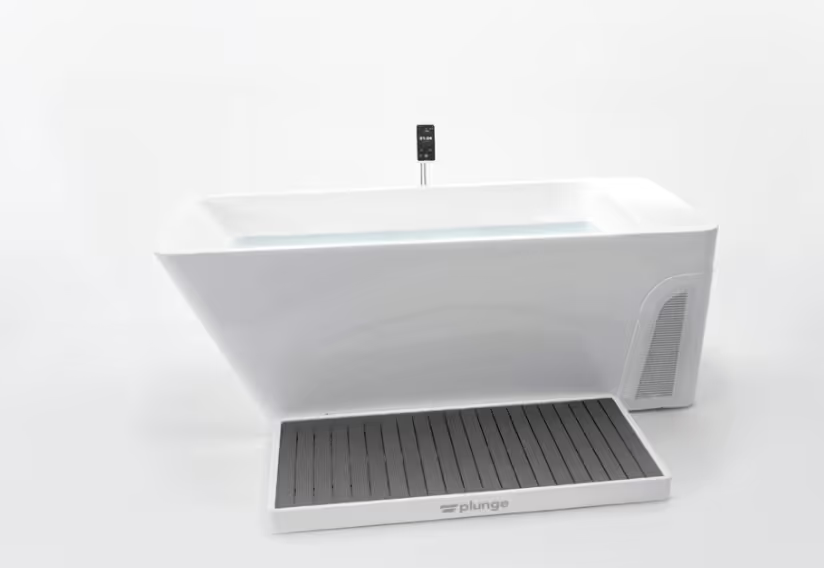
Expert opinion: “Everything is built in (¾ horsepower chiller, filtration, and I believe plumbing is too), so the setup is simply plugging it in and filling it up. It's the most expensive one out of the three, and it's a horizontal tub, which I would avoid. You're paying a lot for the convenience and the app, which is not worth the cost in my opinion,” says Feysa.
If you’re ready to splash out on a luxurious cold/heat therapy setup with all the bells and whistles, consider the All-In Cold Plunge. It’s a horizontal tub, making it best for people who prefer a bathtub or spa-like feel (rather than a quick plunge), but the setup is seamless; all you have to do is fill it up and set the temperature. It cools to 37°F with an ultra-quiet chiller, and it uses ozone sanitation to keep the water clean.
Echelon Smart Cold Plunge: Best Filtration

Pros:
- Cools to 36°F
- Robust filtration
- Ozone sanitation
Cons:
- Chiller is an add-on purchase
Expert opinion: “This has the most robust horsepower at 1.0 compared to the other two, and because of that it goes down to 36°F. But honestly? Most people don’t even come near the thirty-degree mark and typically stay within the mid-40s at best. But it also has the best filtration specs: mesh pre-filter, plus the 20-micron filter and ozone. It's horizontal like the All-In, but costs a lot less. I personally would give up all these features for the vertical tub,” says Feysa.
Echelon’s Smart Cold Plunge is inflatable, but don’t let that scare you off. Since it has the highest horsepower on this list, it provides intense cooling for serious plungers, and it uses 3-stage self-cleaning sanitation. You can use it indoors or outdoors, and it circulates the water to keep temperatures consistent. Even with the chiller being an add-on purchase, this plunge is significantly more affordable than the others on this list.
Wrapping Up: Tips For Your First Plunge
Once you’ve found your perfect tub, keep these tips in mind to make the most of your plunging routine:
- “Don’t start with freezing temperatures. Start with 55 or 50°F for a minute or two to get the hang of it. Then go one degree cooler with each passing week until you get to your ideal temperature.”
- “Aim for a total of 10 min per week broken up into 3 to 5 mini sessions.”
- “Avoid cold plunging for up to 2 to 4 hours after you exercise if your goal is muscle gain. It will inhibit your progress,” says Feysa.
Want to browse a few more options? Peruse the Stridekick Shop for a broad collection of recovery finds.