
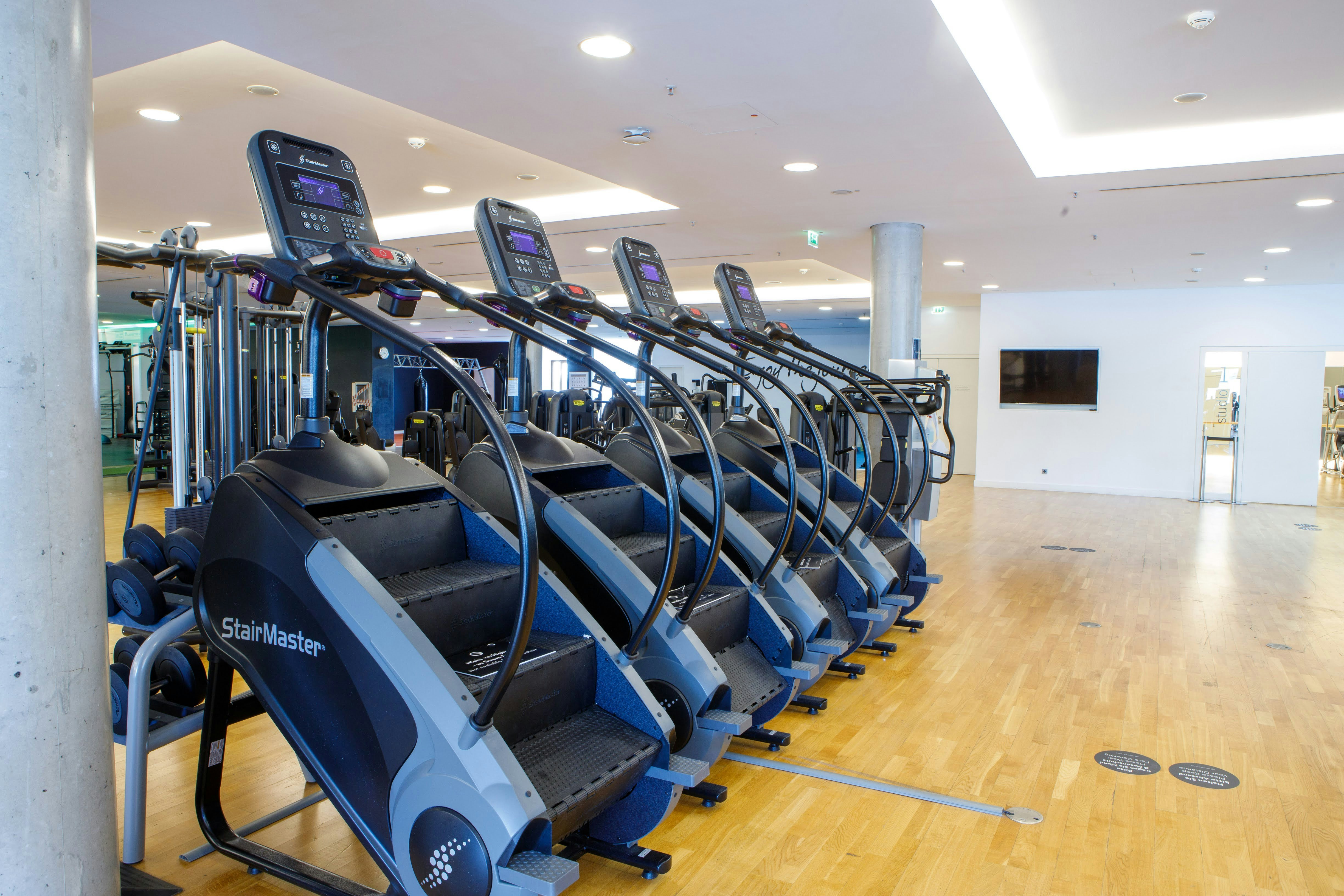
How to Make the Most of Your StairMaster Workouts, According to Pros
Is the StairMaster actually worth the hype? Here’s what fitness pros say about calories, muscle burn, and why it might be your new go-to cardio.
This post contains affiliate links. Stridekick may earn a commission on purchases.
Finding ways to keep cardio interesting at the gym can be, well, tedious. If you love a treadmill run, we salute you, but we need to switch things up before giving in to another skip day. So when we saw stair-stepper machines (AKA StairMasters) blowing up online, we knew we had another workout deep-dive on our hands.
We reached out to two fitness pros to get the complete low-down on stair-stepper workouts, their potential benefits, and whether they deserve a spot in your cardio rotation.
The Experts
- Cori Lefkowith, NASM-CPT, CES, FNS, PES, founder, owner, and head coach at Redefining Strength, author of The STRONG System: Transform Your Mindset and Build Your Best Body at Any Age
- Rob Moal, CPT, founder of Train Like Rob in Vancouver
Stair-Stepper Benefits: Fact or Hype?
Stair-stepper machines stimulate walking up stairs for low-impact cardio and lower-body strengthening. This combo is the greatest benefit of a StairMaster workout, according to our pros.
“Stair-stepper workouts offer a unique combination of lower-body strengthening and cardiovascular conditioning. They can effectively target the glutes, quads, and calves while also improving muscular endurance and overall work capacity. And they’re a great low-impact option for those looking to include more cardio without the joint stress of higher-impact activities like running,” says Lefkowith.
Moal agrees, adding, “The StairMaster delivers a unique combination of cardiovascular and muscular demand that most cardio options can't match. It burns calories at a high rate without the impact stress of running or jump rope, making it a sustainable long-term option.”
How Stairstepping Engages the Lower Body

Aside from its low-impact merits, Moal adds that lower-body engagement is a key reason to give stair-stepping a try. “Ground-based cardio like running and walking relies heavily on momentum; your arm and leg swing propel you forward, acting as a kind of cheat code. The StairMaster removes that. The vertical ascent creates a constant gravity tax, forcing you to lift your entire bodyweight with every single step, which translates to significantly more direct loading through the glutes, quads, and hamstrings.”
And if you struggle with disproportionately small calves (no judgement here), this machine could be the answer to your qualm: “The calves also get meaningful work here. They're notoriously stubborn to develop, partly because they contain a unique combination of slow-twitch (soleus) and fast-twitch (gastrocnemius) muscle fibres. The sustained, weighted step pattern of the StairMaster provides consistent stimulus across both, more so than flat-ground cardio, where calf involvement is largely passive,” says Moal.
Can the StairMaster Help with Weight Loss?
Looking for an effective weight loss strategy that fits into your hectic schedule? Our pros say stair-stepping could fit the bill.
“The StairMaster is one of the more underrated fat loss tools in the gym,” says Moal. “Using the StairMaster can burn 700 to 800 calories per hour, which stacks up well against most popular cardio options. Running burns roughly 600 to 800, depending on pace and bodyweight, and cycling sits around 500 to 600.”
“The bigger edge is time efficiency. Because of the vertical demand, your heart rate spikes fast. You're in your fat-burning zone in minutes, not 10 to 15 minutes into your session like you'd see on a bike or treadmill.”
While Lefkowith agrees that stair-stepping is a solid workout option for weight management, she adds that it doesn’t work alone: “Stair-stepper workouts can support weight loss, but you can’t out-exercise your diet. They’re a useful tool for increasing calorie burn and improving conditioning, which can enhance your overall training and metabolic health. But if you’re relying on cardio alone without dialing in your nutrition, strength work, and daily movement, you’re going to eventually stall out,” she says.
So in the equation of sustainable weight loss, stair-stepping can fulfill the cardio portion, but it needs to be complemented by a balanced diet and regular strength training for the best possible results.
TikTok’s 25-7-2 StairMaster Workout: Fad or Functional?
TikTok sure loves a numbered workout trend (as we learned with the 3-2-8 Method™ and 6-6-6 walking trend), and stair-stepping isn’t immune. Popularized by TikToker Camilla Akbas (@shutupcamilla), the 25-7-2 StairMaster workout involves using the StairMaster twice weekly for 25 minutes per session. Proponents love that it’s a structured yet realistic routine for low-impact cardio, but is it worth a try?
“This can be a great way to improve baseline cardiovascular fitness and increase overall activity levels. But it shouldn’t be your entire plan,” says Lefkowith. “For real changes in body composition, strength, and long-term health, you need a well-rounded approach that includes resistance training, proper recovery, and consistent lifestyle habits. On its own, it’s a good start but not a complete solution.”
Moal offers a similar take, noting its benefits for people trying to get back into the gym: “For beginners or people getting back into exercise, it's a solid starting point. Low commitment, easy to follow, and simple enough to actually stick to. The most important factor in improving your health long-term is building consistent habits, and this workout can be a useful part of that foundation.”
How to Stair-Step Correctly: Form and Technique Tips
Especially when we’re working out early in the morning or after a long day at the office, it’s hard not to slump over those handrails and hope for the best. But focusing on form is one of the best ways to get the most from your stair-stepper workout. Our pros provided these form tips:
- “Don’t just go through the motions—pay attention to what you feel working,” says Lefkowith.
- “The biggest thing to avoid is leaning too far forward or holding on to the handrails too much. Keeping your hands off the rails can burn up to 25% more calories,” says Moal.
- “Try to land and push off from the balls of your feet to get the full engagement of your legs, especially calves and glutes,” says Moal.
- “Small adjustments like these not only improve results but can also help reduce unnecessary stress on the knees,” says Lefkowith.
How to Warm Up Like a Pro
.jpg)
With any form of cardio, it’s best to get your blood pumping before diving right in for better results and injury prevention. Before stair-stepping, our pros recommend foam rolling, dynamic stretching, and a few bodyweight strengthening exercises.
Lefkowith suggests a simple three-part approach: “Start with foam rolling to address tight areas, move into dynamic stretches to warm up muscles and joints then include activation exercises to engage the glutes and core. This helps you make sure everything is working properly to avoid further overload. Even include a few easy minutes before upping the intensity on the machine to completely warm up.”
Moal recommends a very similar strategy: “I would say because of the stronger reliance of the lower body, make sure you foam roll your leg muscles 30 to 90 seconds per part (quads, calves, glutes), [then] a couple of rounds of 30 to 60 seconds side planks and glute bridges paired with sets of clam shells for 20 reps, to make sure the glutes are turned on. And so there's no surprises with calf cramps, 2 sets of body weight single-leg calf raises.”
Stair-Stepper Safety: Keep These Tips in Mind
To stay safe and avoid injuries, our pros recommend following these tips:
- Gradual is the name of the game. “For beginners, the most important thing is to slowly build up. Less is more. Begin at a manageable pace, focus on controlled movement, and avoid relying too heavily on the handrails for support,” says Lefkowith.
- Don’t underestimate it. “Match the intensity to your current fitness level, monitor your heart rate, and stay hydrated. It's a deceptively demanding machine; most people underestimate it until they're on it,” says Moal.
- Stay present. “Pay attention to what you feel working and gradually build both intensity and duration over time. This allows your body to adapt safely and reduces the risk of overuse or strain,” says Lefkowith.
Stair-Steppers from the Stridekick Shop
If you’re ready to go all-in on a stair-stepper for your home gym, the Stridekick Shop has you covered. These options are HSA/FSA-eligible, so you can put your pre-tax dollars to good use.
- The Stairclimber, a compact, portable stair-stepper with three adjustable incline levels and Bluetooth connectivity
- The Summit Stairmill s-22, the Stairclimber’s higher-end alternative with a 22-inch HD touchscreen, side LED light strips, and adaptive power technology that adjusts to your pace
And if you’re not quite sold on a stair-stepper, you can still get your steps in (and have a little fun) with a free step challenge. Happy stepping!